The call usually comes early. A shop owner in Jersey City or Hoboken pulls up to open, and the front pane is in pieces on the sidewalk. Maybe it was a break-in, maybe a delivery truck backed too close, maybe a storm sent a sign through the glass. Whatever happened, a broken storefront window puts you on the clock. You have a security gap, a safety hazard for anyone walking by, and a business that probably cannot open the way it normally does. We have been fixing commercial glass in New Jersey since 1993, and the owners who come out of this in the best shape are the ones who handle the first hour in the right order.
Here is what we walk our customers through, step by step, from the moment they find the damage to the day the new glass goes in.
First Hour: What to Do About a Broken Storefront Window
Put safety ahead of everything else
Keep staff, customers and passersby away from the opening. Broken glass hanging in a frame is more dangerous than glass already on the ground, because a large shard can let go without warning, especially in wind. Do not try to pull loose pieces out with your hands, and do not tape over a pane that is still shedding. If the damage came from a break-in and you are not sure the building is clear, stay outside and wait for police.
Call the police if it was a crime
If someone broke in or vandalized the glass, call the police before you start cleaning up. Your insurance company will almost always ask for a police report number, and officers may want to see the scene as it is. Get the report number and the officer’s name before they leave.
Document everything before anything gets moved
Take wide photos of the whole storefront from the sidewalk, then close shots of the broken pane, the frame, the door hardware and any damage inside. Shoot video while you walk the space. Write down the time you found it and what you saw. This is the record your insurance adjuster will lean on, and it is very hard to recreate once the glass is swept and the opening is covered.
When our crew arrives, we also note the glass type, size and thickness, the frame condition and the cause of damage where it is clear. Owners tell us that written job documentation makes the insurance claim go a lot smoother.
Board Up Now, Replace Glass Next
A lot of business owners expect the glass company to show up with a new pane on the truck. Sometimes that is possible for a small, standard piece. Most storefront glass, though, is cut to the exact size of your opening, and tempered glass cannot be cut after it is tempered. It has to be fabricated to size first. So the usual sequence is a secure board up the same day, then the permanent glass once it is made.
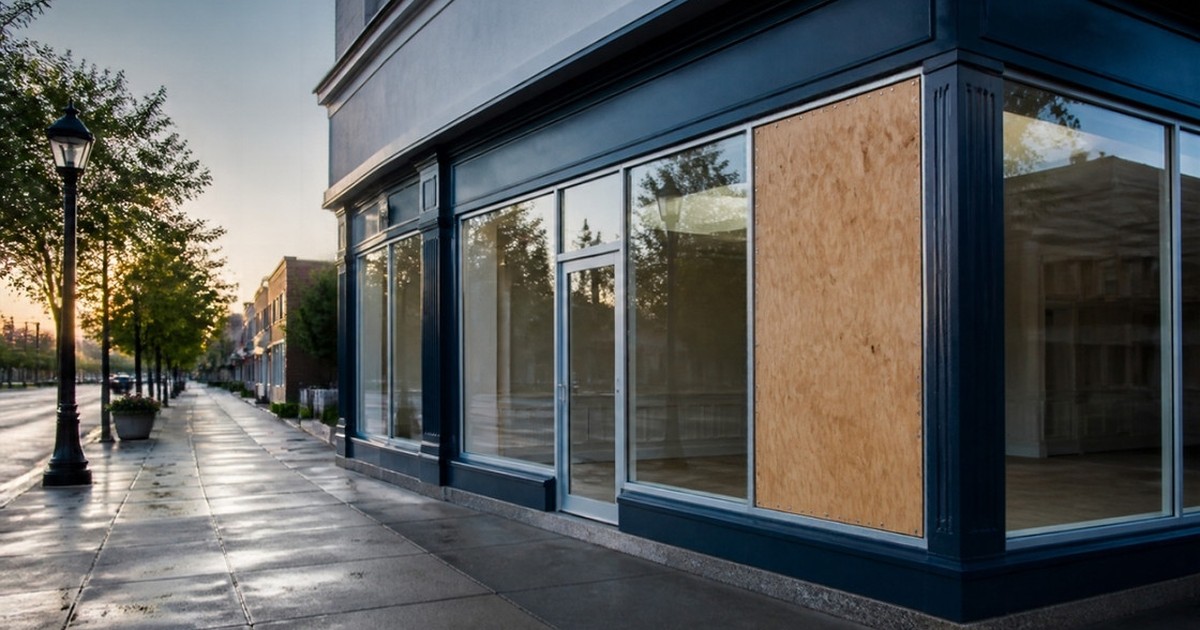
A proper board up is not a sheet of plywood nailed over the hole. It should be fastened so it cannot be pried off from the street, sealed well enough to keep rain and cold air out, and fitted so it does not damage the storefront frame you are going to keep. With November and December on the way, a tight board up also matters for heating costs and for any stock sitting near the window.
Our emergency business glass repair team handles both steps: securing the opening around the clock, and coming back to install the permanent glass, so you are not coordinating two different contractors.
Insurance, Leases and Who Pays
Before you sign off on any work, make two quick calls or checks. You do not need to have every answer, but you should know where you stand.
- Your lease. Many commercial leases spell out whether the tenant or the landlord is responsible for plate glass. Some require the tenant to carry glass coverage. Look for words like “plate glass,” “glazing” or “storefront” in the repair and insurance sections.
- Your insurance policy. Commercial property policies treat glass differently. Some cover it fully, some cap glass per pane or per incident, and some only cover it as part of a covered event like vandalism or a storm. Your agent can tell you quickly.
- Your deductible. For a single small pane, the repair may cost less than your deductible. For a full storefront, it usually will not.
- The adjuster’s timeline. Ask whether they want to see the damage in person before permanent replacement. A board up to protect the property is almost always expected right away.
We do not make coverage decisions, and nobody but your insurer can. What we can do is give you a free on-site estimate and a clear written description of the damage and the replacement glass, which is what adjusters usually ask for.
Repair or Full Replacement?
With a storefront, the answer depends on what actually broke. A shattered tempered pane is always a replacement, because tempered glass breaks into small pieces all at once. A laminated pane is different: it may crack in a spiderweb pattern but stay in the frame, because the plastic interlayer holds it together. That buys you time, but a cracked laminated pane still needs to come out. It is weakened, and it is a much easier target the second time.
Then there is the frame. After a forced entry, we often find bent aluminum, damaged glazing stops, broken door closers or a lock cylinder that was pried. If the frame is still square and solid, we reglaze it with new glass. If it is twisted, new glass will not seat or seal properly, and that is when we talk about frame repair or a section of new storefront. We will tell you honestly which situation you are in.
If your storefront was already showing its age before this happened, our guide to the signs your storefront glass needs replacing can help you decide whether to fix one pane or plan a bigger upgrade.
Choosing Glass That Holds Up Better Next Time
The replacement is a chance to rethink what was in the opening. Building codes require safety glazing in hazardous locations, including glass in and near doors, so many storefront doors and nearby panes are tempered at a minimum. Tempered glass is strong and breaks into small, less dangerous pieces, but once it breaks, the opening is wide open.
Laminated glass is the upgrade most owners ask about after a break-in. Two or more layers of glass are bonded to a tough interlayer, so even when the glass is struck hard, it tends to stay in place and slow someone down. It is not bulletproof and it is not a guarantee, but it changes a smash-and-grab into a much louder, slower job. Laminated glass also blocks most UV, which helps keep displayed merchandise from fading in a sunny window.
Other things worth talking through during the estimate:
Insulated laminated units. If your storefront has double-pane glass, the outer or inner lite can be laminated, so you keep the energy performance and gain impact resistance. Low-E coatings can be added at the same time.
Door hardware. A strong pane in a weak door does not help much. We check the closer, pivots, lock and threshold while we are there.
For a bigger refresh, our storefront glass installation work covers new aluminum framed and frameless systems, custom sized for your opening.
What This Looks Like in Hudson County
Hudson County storefronts take a beating. On busy blocks in Jersey City, Bayonne and Union City, shops sit right on the sidewalk, delivery trucks double park inches from the glass, and wind off the Hudson pushes hard on big panes in the colder months. Older buildings in Hoboken and West New York often have original storefront frames that have been reglazed many times. After a break or impact, we pay extra attention to those frames, because a worn frame is often the reason a new pane does not sit right.
We provide glass services in Hudson County as well as the rest of New Jersey, and the same first-hour steps apply whether your shop is on Central Avenue or Main Street in a quiet suburban downtown.
Frequently Asked Questions
Can I stay open with a broken storefront window?
Sometimes, if the broken glass is fully removed or secured and the opening is boarded so nobody can be hurt. Never stay open with loose or hanging glass in a frame near customers or a sidewalk. If the door itself is damaged, you may need to keep that entrance closed until it is fixed.
How long does a storefront glass replacement take?
A board up can usually be done the same day you call. The permanent glass depends on the type and size. Standard clear glass is faster to get than tempered, laminated or insulated units, which are made to order. We give you a realistic timeline at the estimate instead of a guess.
Should I clean up the glass myself?
Take your photos first. After that, sweeping glass off the sidewalk and floor with heavy gloves and a broom is reasonable. Leave anything still in the frame to the glass crew, because removing hanging glass safely takes the right tools.
Will laminated glass stop a break-in?
No glass makes a storefront impossible to get into. Laminated glass makes it much harder and slower to get through, and it usually stays in the frame after an impact, which is why many New Jersey retailers switch to it after their first break-in.
Get Your Storefront Secure Today
A broken storefront feels like a crisis, but it is a problem with a clear fix: stay safe, call the police if needed, document it, get the opening secured, sort out insurance, then put back glass that is better than what you lost. Luso Glass is a family-owned company, licensed and insured, with our own install team and 24/7 emergency service. Call us at (973) 820-3489 or request a free on-site estimate, and we will help you get back to business.